
Hartford County Parole Versus Probation
Parole and probation can both follow a criminal case, but they begin in different ways. Parole permits a sentenced person to leave a CT DOC facility before the full custodial term ends, subject to community supervision. Special parole is also tied to a sentence and follows the terms imposed in the case. Probation is ordered by a court, often with a suspended part of a sentence, and is administered through the Connecticut Judicial Branch Court Support Services Division. Someone released from Hartford Correctional Center on pretrial bond is not on parole merely because the person left the facility.
The court disposition is the sound first record for probation. CT DOC status and release fields, Board of Pardons and Paroles records, and Parole and Community Services are the stronger routes for parole. The Connecticut Prison System service page describes Parole and Community Services as the consolidated community supervision and enforcement function of DOC and the parole board. Hartford is one of its field-office bases.
| Point | Parole or special parole | Probation |
|---|---|---|
| How it begins | Release from a sentenced CT DOC term under parole authority or sentence terms | A Judicial Branch court order in the criminal case |
| Main record trail | CT DOC status, BOPP materials, and Parole and Community Services | Court disposition and adult probation records |
| Physical custody | The person is normally outside the facility but still supervised | The person may receive probation without a prison release to parole |
| How it ends | Discharge, expiration, or other official action reflected by the supervising system | Completion, discharge, or court action reflected in probation and case records |
- Parole
- Conditional community release from a custodial sentence under parole authority.
- Probation
- Court-ordered community supervision that is distinct from parole.
- Special parole
- A sentence-based period of parole supervision following incarceration.
- Discharge
- The formal end of a custody or supervision status.
Verify Hartford County Post-Release Supervision
A careful check starts with identity and legal status, not a broad name match. Hartford Correctional Center holds many accused, unsentenced people as well as people in other DOC statuses. Current incarceration does not itself prove a conviction. Likewise, leaving Hartford CC can mean bond, court movement, transfer, a hospital movement, release to supervision, or discharge.
- Search the CT DOC inmate information system by DOC number when known, or use the first few letters of the last name. Confirm the date of birth and identifying number.
- Read status, current location, sentence dates, release-date fields, detainer, and special-parole information when shown. A changed location is not enough to establish community release.
- Check the Judicial Branch convictions search for the disposition. The sentence record is the key route for determining whether probation or special parole was ordered.
- For parole, review the Connecticut Board of Pardons and Paroles resources and the posted hearing materials. Do not infer a result merely because a name appeared on a hearing list.
- Contact the proper supervision agency if the public sources do not answer whether the term remains active. Give the full name, date of birth, DOC number if known, case location, and docket context.
For the broader custody and release-record path, the Hartford County released-inmate search explains how DOC, court, notification, and records-request results fit together.
Note: Connecticut DOC information updates daily, can change fast, and excludes youthful-offender information and people held for ICE.
Hartford Parole Supervision Office
Hartford has a real role in the statewide supervision network. CT.gov identifies Hartford among the field-office bases for Parole and Community Services. Officers in that division monitor compliance with release conditions in the community. The source does not provide a public person-by-person supervision directory, so a general web search should not be treated as proof that a named person is assigned to a specific officer or office.
CT DOC Parole and Community Services
Hartford is a listed field-office base.
Use the statewide Parole and Community Services information to locate the proper official channel.
State Adult Probation
860-721-2100
Use for Connecticut Judicial Branch adult probation routing after confirming the sentence in the court record.
Parole and probation records do not merge simply because the person lives in Hartford County. A supervising office may depend on the release plan and assigned district, while the court case may be associated with Bristol, Enfield, Hartford, Manchester, New Britain, Rockville, or another court served by Hartford CC. Provide the correct case location when seeking help.
Hartford County Parole Hearing Records
The Connecticut Board of Pardons and Paroles provides parole resources, hearing information, a public meeting calendar, annual revocation reports, and eligibility material. Its hearing page carries current dated listings and virtual links. Hearings start at 9 a.m. unless a posting says otherwise, and current proceedings use MS Teams or Zoom streams.
A hearing listing shows that a matter was scheduled. It does not by itself establish that parole was granted, denied, continued, revoked, or rescinded. No separate public BOPP decisions search was found in the Hartford research. Board action may instead appear through BOPP records, CT DOC status or supervision fields, posted meeting material, and an FOI request. The board says copies of hearings may be requested at BOPPFOI@ct.gov. Recording the live stream, including screenshots, is prohibited under C.G.S. § 1-226.
The manifest image below comes from the official board resource page and shows the state-level source that supports a Hartford County parole check.
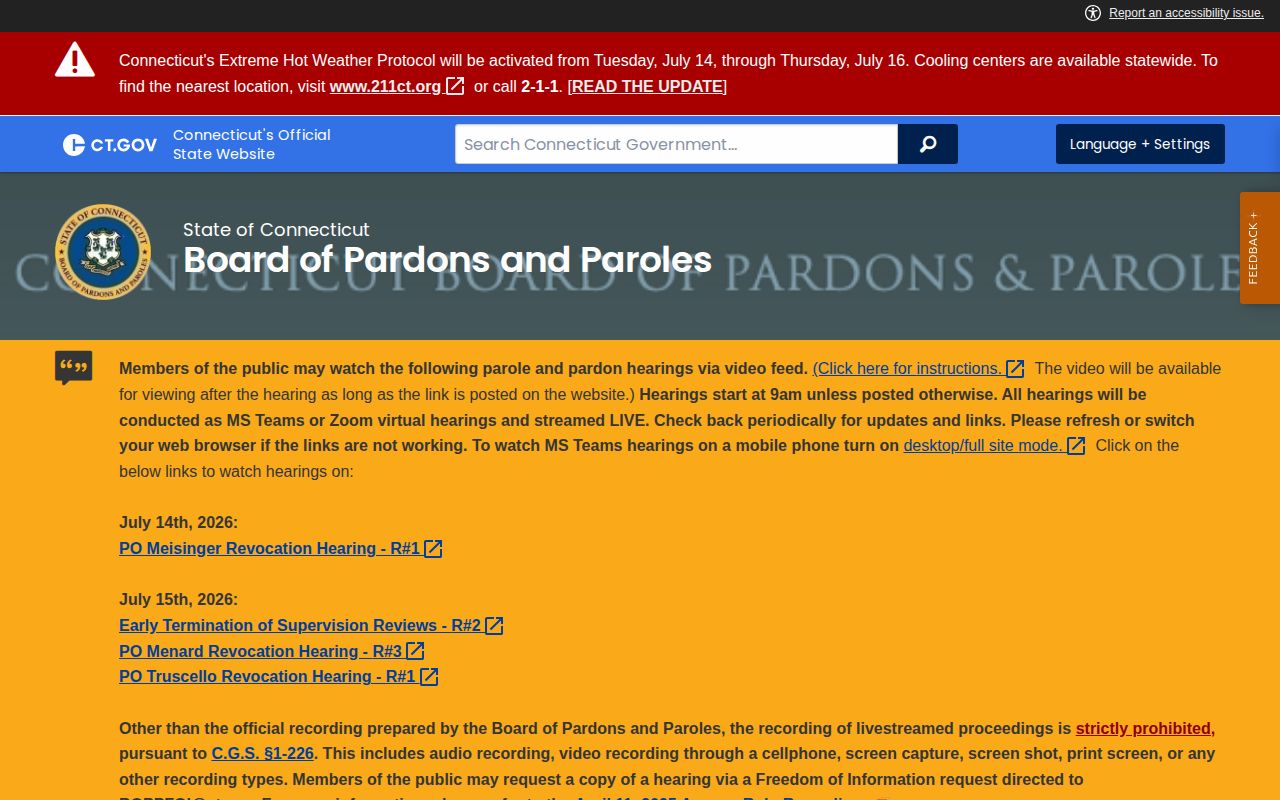
Use those board links with the DOC and court records because each source answers a different part of the supervision question.
Note: BOPP hearing links are date-specific, so consult the live hearing page and public meeting calendar for current postings.
Hartford County Parole Eligibility Rules
A parole eligibility date is not the same as a release date. Connecticut regulations define it as the earliest date on which an inmate may be allowed to go at large on parole under C.G.S. § 54-125a. Eligibility gives the board legal authority to consider release; it does not promise a grant. A maximum or estimated release date in DOC data serves a different purpose.
The BOPP eligibility page states that violent-offense cases must serve at least 85 percent of the total effective sentence, less jail credit, before the board may parole them. For offenses committed on or after July 1, 2013, risk-reduction earned credits do not reduce that 85-percent parole eligibility date. The board also lists offenses that are generally parole-ineligible and notes that youth-offense provisions can alter eligibility for some people.
Do not calculate an individual Hartford County release from those rules alone. Jail credit, the exact offense, sentence documents, statutory dates, and board action all matter. CT DOC and BOPP are the proper sources for the actual record.
Hartford Parole Absconders and Warrants
An absconder is a supervised person alleged to have stopped reporting or otherwise left supervision without authorization. A violation allegation does not explain the final outcome. It may lead to investigation, a warrant, remand, a revocation hearing, continuation, or another official action. Court, DOC, and BOPP records must be read together before drawing a conclusion.
Connecticut DOC operates a narrow fugitive-tip channel. CT.gov says its Parole Fugitive Investigations Unit seeks tips about parole absconders, transitional-supervision escapees, and other high-profile cases. The line is available at (860) 982-2372 and the email is CT.FUGITIVE@ct.gov. This is a public-safety tip route, not a general Hartford County parole lookup, case-status line, or way to ask about ordinary supervision terms.
For a normal verification request, use DOC inmate information, the court disposition, BOPP sources, and the supervision office. A return to a DOC location may indicate remand, but only the official record can explain why.
Greater Hartford Release and Reentry
Supervision is only one part of the transition after release. Community Partners in Action operates the Greater Hartford Reentry Welcome Center, and the City of Hartford describes it as a one-stop hub for case-management support and community connections. Help can begin on the first day of release from CT DOC or through a walk-in.
Greater Hartford Reentry Welcome Center
716 Windsor Street
Hartford, CT 06120
(860) 263-8476
Monday through Friday, 8:00 a.m. to 4:00 p.m.
This center does not determine parole status or replace a supervising officer. It is a local reentry connection. The supervision record still comes from CT DOC, BOPP, or the Judicial Branch, depending on the sentence.
The official source image below supports the local reentry section; the City of Hartford also describes the center's day-one and walk-in role.
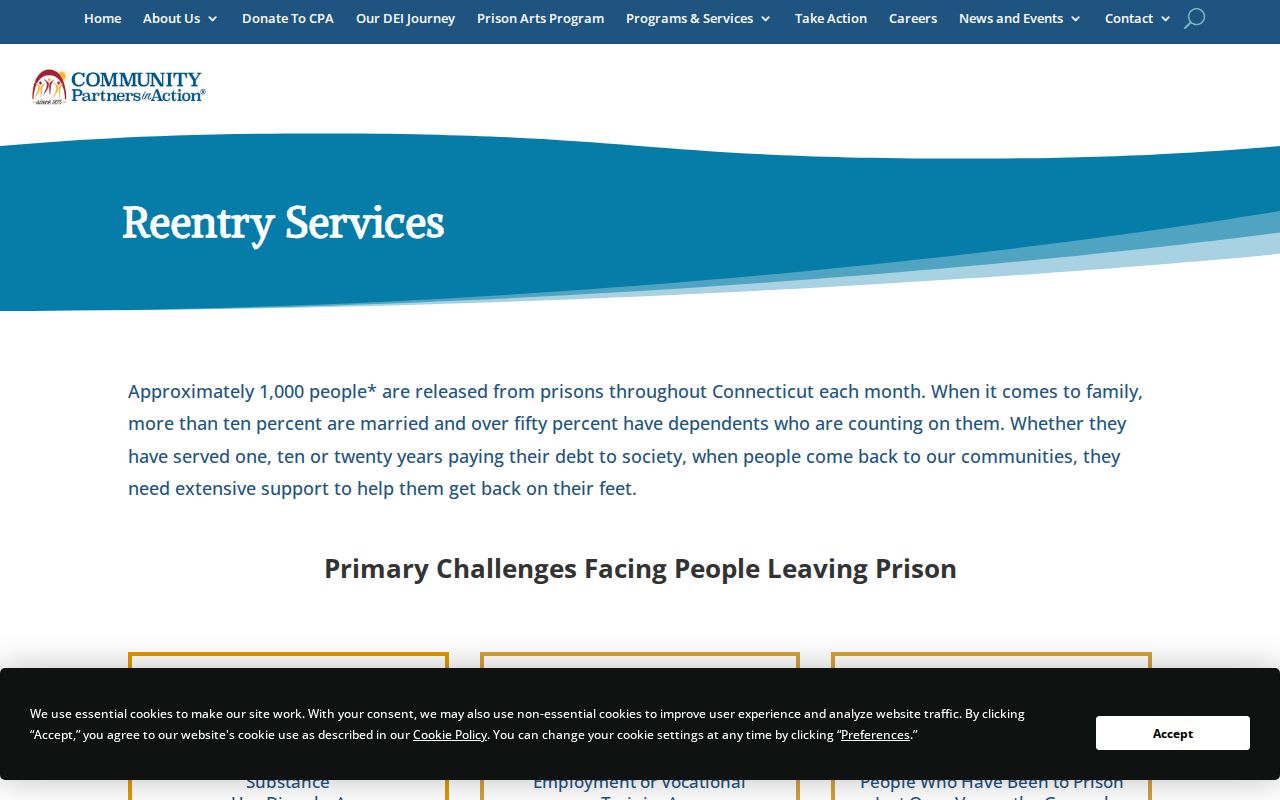
Its Hartford address and same-week service hours make it a practical local resource once release has been confirmed.
Hartford Release ID and Property
Personal identification may remain in Connecticut DOC storage after release. According to 211 Connecticut's ID retrieval guidance, a person should contact DOC Central Office Reentry Services when more than 30 days have passed since release. The guidance says personal identification remains secured at Central Office for two years.
CT DOC Offender Reentry Services Unit
24 Wolcott Hill Road
Wethersfield, CT 06109
(860) 692-7869
Fax: (860) 692-7586
This route concerns stored identification and reentry support, not supervision verification. CT DOC Offender Reentry Services also states that each facility has a full-time Reentry Counselor. A newly released person should follow the instructions received from the facility or assigned officer when the release is recent.
Note: Do not send private identity documents to an unofficial address; first confirm the current DOC unit and its delivery instructions.
Hartford Supervision Alerts and Registries
Connecticut VINE provides custody-status and criminal-case information, notification registration, and victim-service routing. It can alert a registered person to a custody change, but it does not certify that parole or probation began or ended. CT DOC, BOPP, and the Judicial Branch remain the official supervision sources.
The DESPP Sex Offender Registry is narrower. It applies only when a released person has a qualifying registration duty and can include a last known address, physical descriptors, and offense details. It is not a Hartford County parole roster or a general list of people under post-release supervision. DESPP also cautions that registry inclusion is not an individual finding of current dangerousness.
Note: A notification result and a supervision record serve different purposes, so verify each status with the agency that created it.
When Hartford County Supervision Ends
Supervision ends through an official discharge, expiration, court order, or other authorized action. Leaving a facility starts parole in many cases; it does not end the sentence. Probation likewise remains active until its court-set term ends or a court changes it. A parole hearing, a favorable recommendation, or a missing online entry should not be read as discharge.
Confirm the endpoint through the agency that owned the supervision. For parole or special parole, seek CT DOC or BOPP records. For probation, use the Judicial Branch disposition and adult probation route. If an existing record is needed, a focused FOI request can ask for the nonexempt status or discharge record. Connecticut VINE can report custody changes, but it is a notification system rather than a certified supervision-discharge record.
Connecticut FOIA makes nonexempt public-agency records accessible under C.G.S. § 1-210, but safety, security, erased-record, youthful-offender, and other legal restrictions can narrow what is released. An absent public record therefore does not establish that supervision never existed or ended on a guessed date.
A final status check should also account for detainers or a move to another authority. Release from CT DOC custody may lead to federal or immigration custody, and that is not community discharge. The name of the agency, the effective date, and the exact status field are essential.